Frauenberg

IMG_0688 (Small)

As far as I know, there is at least one other, somewhat more famous, ‘Frauenberg’: the Rheinhessen cru which, in no small measure, owes its renown to the exploits of Klaus-Peter Keller and Hans Oliver Spanier.

This particular Frauenberg, on the other hand, overlooks Mauchen, a sleepy village in the borough of Müllheim in Südbaden.

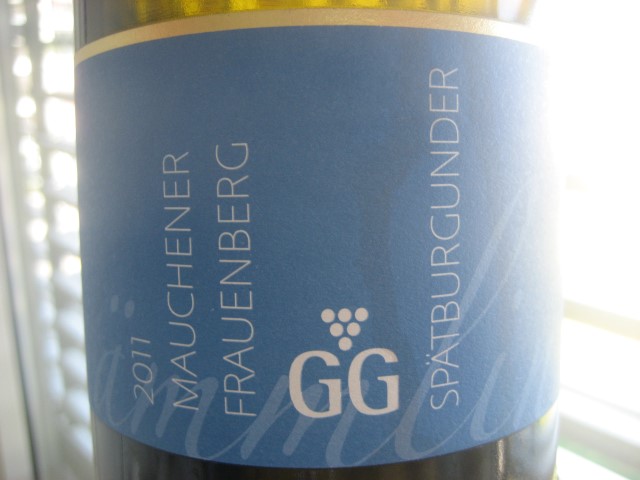
Lämmlin-Schindler, Frauenberg Spätburgunder GG 2011, Baden
Quite dark and dense for a Pinot, with a surprising purplish tinge around the edges. An initial whiff of raspberry and blackberry on the nose, followed by a suggestion of apple. Earthy, rusty, blood-like hints, along with a sprinkling of wild herbs. Stuffing and structure on the palate, though quite softly-softly in terms of its flavours (merely a little raspberry and some green stemminess).

After leaving the wine half-full in the fridge, I return to it five days later. Certainly quite a lot more open now, with black cherry as well as dried herbs and a spicy, slightly animally note on the nose. In the mouth, it’s less about the flavours and more about the tannins – which are supple and minerally. This is a beefy wine, albeit one with a good acidic backbone and considerable potential lurking underneath. There is nothing limpid about it at all. Definitely Pinot, but in a different idiom to the elegance, transparency and leanness of many its cousins nowadays. Grand cru where the emphasis is on stature and masculinity. I’d give it at least another five years.

Standard

Two countries, two wines, one grape.

With one or two similarities …

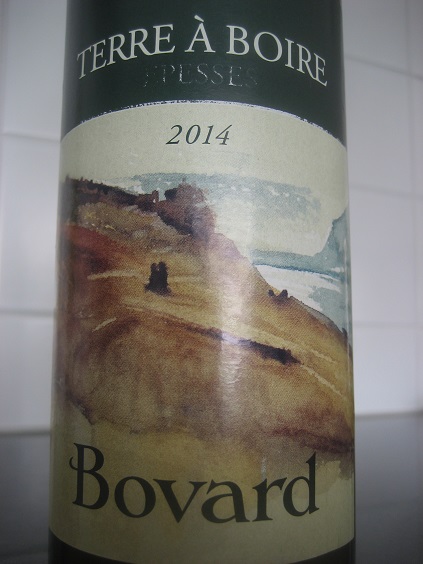
Louis Bovard, ‘Terre à Boire’ Épesses 2014, AOC Lavaux, Vaud
On receiving the Gault Millau award for Germany’s ‘wine collection of the year’ in late-2014, local grower Hanspeter Ziereisen from Efringen-Kirchen name-dropped Switzerland’s Louis Bovard as being a producer he admires. This was in my mind while drinking this.

IMG_0654Golden straw in appearance. Reticent at first but opening up gradually, this is a quiet, unassuming representative of the Chasselas varietal (referred to as Gutedel in Germany). Notes of iron and Golden Delicious on the nose, with slight hints of caramel. Very clean and linear on the palate, with a concentrated, almost peach-like characteristic along with Golden Delicious again. Balanced with a touch of chalkiness lending just enough freshness. The abv is 12.5 per cent. Light to medium body, medium length on the finish. In practice, this is an entry-level wine – but one offering good refreshment. I seriously need to try Bovard’s Médinette from Dézaley one day.

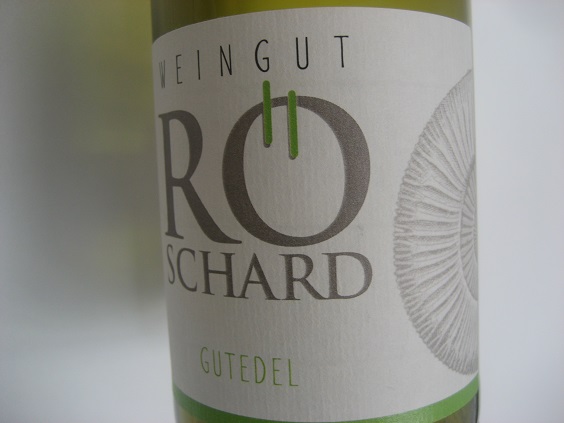
Röschard, Gutedel trocken 2015, Baden
A few of this Weil-based producer’s wines impressed me at this year’s Müllheimer Weinmarkt, including this one. Straw-coloured with slight hints of chalk, hazelnut and pear. Very pure and ‘straight down the line’ – like it’s Swiss cousin. And elegant too. Dry as a bone in the mouth, but juicy and mouth-watering. Light to medium in body, with apple and pear striking the main chords. A refreshing medium finish. Sometimes, simple pleasures like these are the best. Empty in no time. The abv is 12 per IMG_0655cent.

Standard

Millésimes Alsace

IMG_0572Hauptsache Wein is a German-language Facebook group I joined a while back. I like to browse through the various posts and threads from time to time but prefer not to get involved in the discussions, which can sometimes get quite heated. One lively exchange a couple of months ago concerned a recently published selection of sound bites from Alsace and German winemakers on what they thought of the Rieslings produced by their respective counterparts across the Rhine. Personally, I thought some of the views from the Alsace camp were a little uninformed, to put it euphemistically. Of course, this cooked up a mini-firestorm. A debate then ensued on the merits of Alsace wine, during the course of which Stephan Reinhardt from The Wine Advocate – who had posted the link in the first place – mentioned that the third edition of ‘Millésimes Alsace’ would be taking place in June.

Held every other year in Colmar, Millésimes Alsace is a professional fair that showcases the best of Alsace to the wine trade. As Colmar is only a 40-minute train ride from Basel, I thought it would be a good opportunity for me to re-acquaint myself with the region – I worked at a vineyard in Pfaffenheim, just south Colmar, in the summer of 1998, but my exposure to the region since then had been minimal.

For a good background synopsis on Millésimes Alsace, read Sue Style’s interesting account on her website. I chose to visit the centrepiece of Millésimes Alsace, which was the trade tasting on Monday 13 June.  The day also included a ‘masterclass’, which had three scheduled time slots to cater for French, German and English speakers respectively. The other Millésimes Alsace events – which I had to miss – including a guided tour of an Alsace grand cru theIMG_0574 - Copy (2) following day.
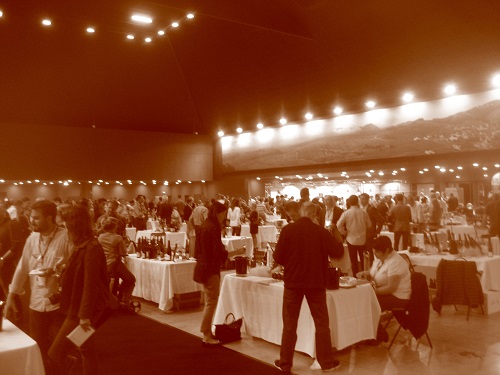
Over the course of the Monday, I decided not to make too many notes while wandering from stand to stand. I just wanted the whole experience to wash over me. Not only was the entire who’s who of Alsace wine in attendance, but wine journalists such as Jancis Robinson and Jamie Goode from the UK, not to mention Stephan Reinhardt, had also made the journey to Colmar. Each producer showed a selection of around half a dozen wines. Around 50 per cent of all the wines were Riesling. Very few showed ‘2015’ on the label; virtually all of were older or much older.

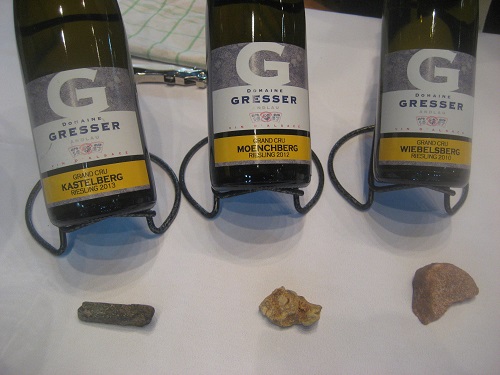
Impressions? In general, they were very positive. Many of the wines had character and complexity in abundanceIMG_0577, firstly demonstrating the worth of holding back vintages for a few years, and secondly, showcasing the varied characteristics of the region’s top vineyard sites (or terroirs, if you prefer). As much as I failed to get round half as many of the producers as I wanted, I was able to immerse myself fully in the respective wine collections I did manage to taste. One notable highlight for me was Domaine Gresser, from whom I tasted a wonderfully vivid, bone-dry 1985 Grand Cru Moenchberg Riesling as well as a selection of other Rieslings (Duttenberg, Wiebelsberg, Kastelberg) that were vibrant mirror images of the different soils in which they were grown.
Other names worth mentioning include:
Muré – Beautiful Rieslings and Pinot Noir.
Louis Sipp – An amiable man (Étienne Sipp) producing eloquent Rieslings from a whole variety of soils, including a deeply mineral 2010 GC Kirchberg.
Marc Tempé – Individualistic and exciting. Biodynamic.
Léon Beyer – Old-school Alsace: Rieslings that are bone dry and austere in their youth and need many years to reach their full potential.
Barmès-Bucher – I loved their superb, minerally Brut Nature and dry Pinot Gris (Lieu-Dit Pfleck 2013).
Pierre Frick – Neighbour of Jean Ginglinger & Fils whom I worked for in 1998, Monsieur Frick puts minimal or – in a few cases – no sulphur at all in his wines. His collection was totally different to anything else on offer, often reminding me of cloudy, oxidative apple mead. It’s an acquired taste, but his Sylvaner Bergweingarten 2013 and Riesling Crémant 2014 are worth looking out for.
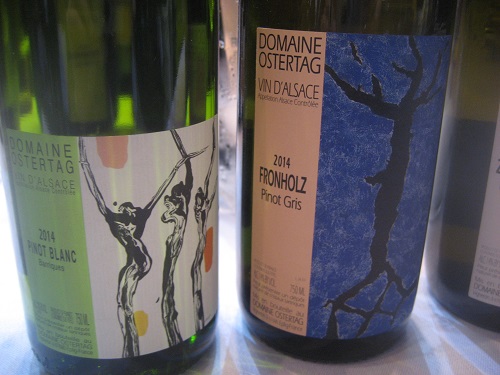
Ostertag – A couple of delicious dry Pinots Gris , along with a phalanx of superb Rieslings of which the most approachable and easiest to understand was the big, bold 2014 Heissenberg.
Trimbach – I couldn’t forgo a sip of the legendary Clos Ste Hune (2008 and still a baby), but the 2009 Cuvée Frédéric Emile was also extremely impressive.Zind-Humbrecht – I was pushed for time as it was nearly time to catch my shuttle bus  back to the railway station, but a 2008 Clos Windsbuhl stole it for me.

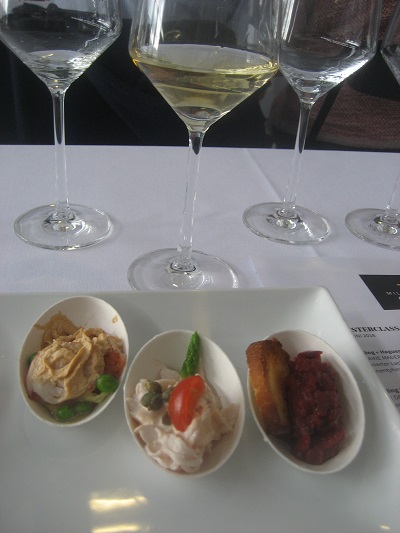
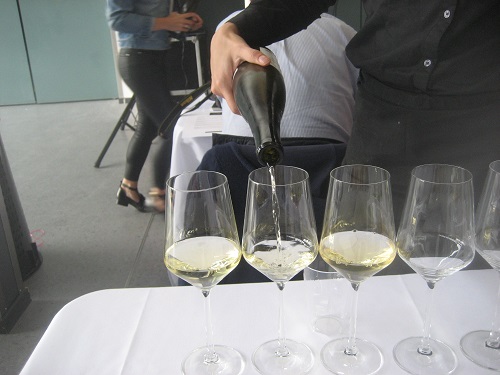
The Masterclass in English IMG_0584– ‘Alsace Riesling – A Friend of Fine Dining’ – was already fully booked up, so I attended the German equivalent instead, presented by sommelier Christina Hilker, in which five different Rieslings were paired with five respective amuses-bouches. A very enlightening side-event, and a privilege to experience. In particular, the 2009 Cuvée Frédéric Emile from Trimbach and the beef tartar with ginger was a match made in heaven. And served in a magnum (or maybe even larger), the Schlossberg 2008 from Domaine Weinbach was simply a treat.
As I travelled back to Basel that evening – luckily having missed the train strike – I concluded that Alsace produces some incredibly fine, world-class white wines. Such a pity that I had neglected them for so long. Although some of the German winemakers interviewed in the link I included at the beginning of this post seem, on the other hand, to genuinely admire the work of their Alsatian counterparts, Alsace wine has suffered from an image problem in Germany over the last decade or so on account of wines judged to be overly sweet and baroque – ironic, given that this is the same image problem that Germany has had to deal with in the past. In any case, Alsace wines – well, the Rieslings at least – seem to me to be drier than their recent reputation would have us believe. IMG_0582
Finally, on a personal note, it was a very pleasant surprise to receive accreditation for this event at all. I am not a wine journalist; I only write a blog – which is why I all the more grateful to the organisers, the Conseil Interprofessionel des Vins d’Alsace (CIVA), for letting me attend.

Standard

Pfeffingen’s best dry Scheurebe

This was my final bottle. For a while I had been hesitant about opening it for this very reason – the eternal dilemma of an amateur wine lover. This time I threw caution the wind.

005

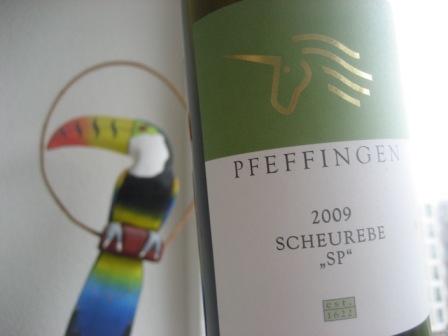
The exotic Ecuadorian bird hanging in my office, plus a bottle of Scheurebe.

Pfeffingen, Scheurebe SP trocken 2009, Pfalz
I’m glad I did open it – the impression it made will provide me with plenty of mental sustenance and consolation now that drinking the 2009 vintage of this wine is an experience I most likely will never be able to repeat.

Golden in appearance. Initially grapey, minty and slightly lemony on the nose. There is only a very slight hint of wood to begin with, and even that melts away completely after a while. If truth be told, I’m searching in vain for the descriptor that does justice to what I can smell, but coriander and/or fennel and/or root veg also spring to mind. Close my eyes and I find myself adding Riesling-esque peaches to the equation.

Despite this, I wouldn’t necessarily brand the wine as excessively aromatic or loud. It retains a certain ‘breed’ throughout, as it were. My impressions on the palate bear this out: above all very grapey, with a mix of fine fresh herbs such as mint and coriander again, as well as a squeeze of lime. According to the producer, the white wines of the Loire were a source of inspiration for the wine. One third of the juice fermented in American oak. However, the woody notes are fully integrated now. That is to say, you know they are there but you barely notice them, if at all. Instead, they add a backbone or an added layer of savoury, tactile complexity, while complementing what to me screams of chalky minerals. Essentially, the wine is also quite powerful and ripe – but not overripe – in the mouth, yet imbued with great freshness. It leads into a very long finish that reminds me on the one hand of a top German Sauvignon Blanc (think von Winning) and, on the other, of an equally good Weissburgunder from Baden on account of its sheer grapiness. All this may sound a little high-octane, but this Scheurebe is that good.


Standard

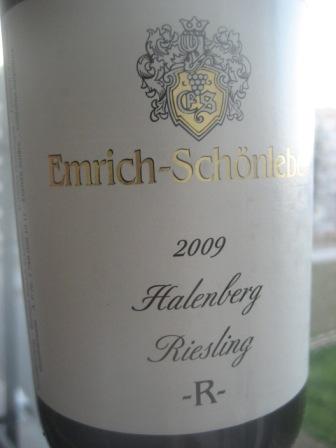
Halenberg R 2009

012Last tasted about a year ago, I couldn’t resist opening another bottle recently. I tried the first bottle in early 2013. Here is a relatively short synopsis of the third bottle (I now have three bottles to go).
Emrich-Schönleber, Monzinger Halenberg, Riesling – R – 2009, Nahe
Bright golden yellow. Quite open and expressive. Succulent, exotic and creamy on the nose, with notes of orange and drippingly overripe, yellow-fleshed peach. A thin film of creaminess and succulence continues onto the palate, coating the inside of my mouth. Medium- to full-bodied. Highly complex and saline. There is just enough ripe acidity to lend refreshment and urgency. Persistent on the finish. Utterly delicious – and up there with the best – in its off-dry idiom.

Standard

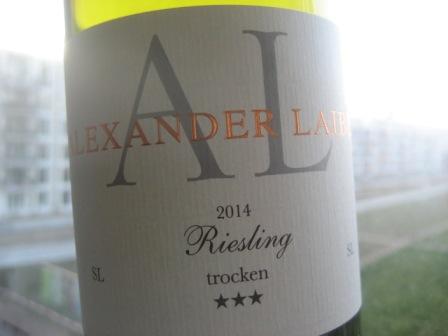
Riesling ‘SL’ 2014

Quality-wise, this wine occupies a higher echelon in Alexander Laible’s range compared to the previous offering I covered a few weeks ago.

Alexand015er Laible, Riesling ‘SL’ trocken 2014, Baden
Vivid yellow verging on golden. As with the Alte Reben, the ‘SL’ gives off a distinctly sweaty whiff – which is unfortunately the best scientific descriptor I can find. Yet, this is just a passing sensation which dissipates by the time I return to the wine 24 hours later. On the one hand, the nose features red fruits such as cherry and strawberry. On the other, I can smell succulent, dripping apricots. The overall effect is quite voluptuous.

Great concentration on the palate, with apricot again. This wine would be almost baroque were it not for a fine vein of acidity keeps things taut and together. Laible’s ‘SL’ is indeed a step-up from the Alte Reben, courtesy of its density and length. Again, very impressive – and further proof that Baden isn’t just about the Pinot varietals.

Standard

Müllheimer Weinmarkt

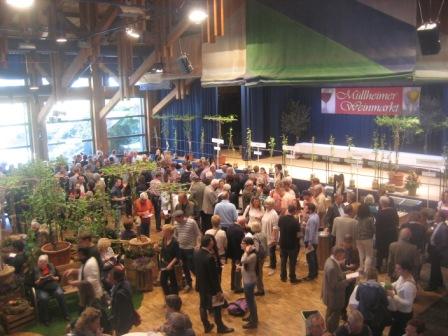
002At long last, I attended the annual (and 134th) Müllheimer Weinmarkt yesterday. The Weinmarkt in Müllheim is a one-day event that normally takes place on the final Friday in April, hot on the heels of the presentation of the annual Gutedel Cup awards in the nearby spa town of Badenweiler. Held at Müllheim’s municipal functions hall, the Bürgerhaus, the Weinmarkt gives the public a chance to taste through the entire spectrum of wines produced in the region of Markgräflerland.
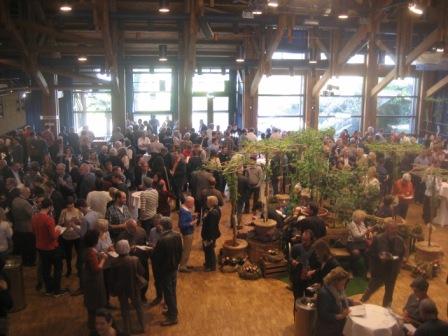
Unlike similar tastings, the producers themselves aren’t the ones pouring the wines. Instead, the various stands are categorised according the various grapes – from Gutedel and Weissburgunder, through to Sauvignon Blanc and Spätburgunder. Behind each stand, women in traditional Markgräfler dress serve the different wines. For example, Gutedel – which, alongside Spätburgunder, was easily the most populous category – boasted a total of 73 wines. All I needed to do was tell one of the women the number – as indicated in the official programme – of a particular wine I wanted to taste, and she would then pour me that wine. Simple really, and quite refreshing if you just want to focus on the wines and not be looked up and down by someone quizzing you every minute as to what you (think) you can taste.

That said, the Müllheimer Weinmarkt is very much a social gathering. First, you had the lengthy intros at the beginning, featuring speeches from local bigwigs, the customary handful of wine princesses, and Markus Büchin (of Haltinger Winzer and Weinhaus Büchin), the new head of local wine association Markgräfler Wein e. V. Only after this seemingly never-ending purgatory of proverbial backslapping on the stage (around 45 minutes of me regretting that I’d arrived so early) were the public able to start tasting the wines. I once attended a similar local event up in the Pfalz, but at least the organisers back then had the good sense to shoehorn their speeches into proceedings while people already had wine in their glasses … Second, it felt like many had simply turned up for a few nice glasses of Gutedel and a good old chinwag. Indeed, the Gutedel stands were the most crowded. However, I eventually managed to taste my way through a good cross-section of what Markgräflerland’s most popular grape has to offer. This in itself was informative and worthwhile – I can’t think of many other events that offer such a broad overview so efficiently.

So, what were my impressions of the wines? Starting with Gutedel, the wines that impressed me the most were the ones that had minimal residual sweetness – fermented virtually bone dry with no more than, say, 2 or 3 g/l of RS, but still tasting light and balanced. This was definitely the common thread separating the wheat from the chaff. Wineries that stood out in my mind in the Gutedel category were Claus Schneider from Weil am Rhein (with their distinctly mineral Weiler Schlipf), Schlossgut Istein (big surprise), H. Schlumberger from Laufen, Dörflinger from Müllheim, Blankenhorn from Schliengen, and (another big surprise) Röschard from Weil am Rhein. That is not to say that some wines up around the 4-to-6-g/l range weren’t very good, but others for me tasted a little blowsy and banal at times. At the same time, some producers had obviously sulphured their Gutedels more than others, making it hard to pass judgement either way – which was a pity. The breadth of styles was another factor to take into account: from feather-light and fresh, to fairly weighty and a bit woodsy.

With the notable exception of Sauvignon Blanc and similar aromatic varietals, I also tasted003 my way through a lot of the various other white grapes, including a very small selection of Rieslings – all three of them were good: from Kaufmann (Efringen-Kirchen), Schlossgut Istein and H. Schlumberger. I was particularly impressed by Schlossgut Istein’s interpretation – a bottle or three of which I may very well want to buy. In terms of the white varietals from the Pinot family, Blankenhorn and H. Schlumberger shone, although I must admit that I skipped a few good wines that I had tasted and knew already (e.g. Claus Schneider, Dörflinger).
Then came Spätburgunder and the sparkling wines at the end. This was also very rewarding. Most of the Spätburgunders were still very young and undeveloped, but, even at this infantile stage, some wines blew me away. Notables? Both 2013 Pinots from Schlossgut Ebringen (Biegarten and Leinele), the estate wine from Schlossgut Istein (great value for money), Lämmlin-Schneider’s monumental 2012 Frauenberg, Heinemann’s 2013 ‘Selektion SR’, Röschard again (both their ‘simple’ estate and their Pinot aged in large oak casks), the ubiquitous Schneider estate with their Weiler Schlipf CS***, and both of H. Schlumberger’s wines (Altenberg, VDP.Erste Lage; Wingerte, VDP.Grosse Lage). A shout also goes out for the lone Merlot from Dr. Schneider in Müllheim-Zunzingen – a very light-footed, elegant wine.

In terms of the bubbly, all four by Reinecker stood out (particularly their ‘Cuvée Classic’), as did the ‘Brut Nature’ from Winzergenossenschaft Britzingen, and the strawberry-tinged ‘Extra Brut’ from Lämmlin-Schindler (a blend of Spätburgunder, Weissburgunder and Chardonnay).

By the time I had finished tasting, I was both thirsty and hungry. A couple of ‘reparatory’ beers and a Wiener Schnitzel at the Alte Münz sorted me out before I caught the train back to Basel.

Standard

Brennfleck, Silvaner

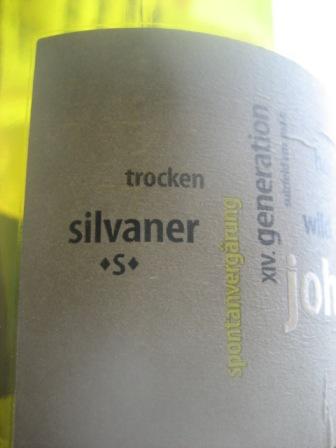
003I’ve always tended to be slightly indifferent when it comes to Silvaner. Aside from the fact that those traditionally shaped Bocksbeutel bottles from the grape’s heartland of Franconia are as visually alluring to me as a bottle of cheap Lambrusco, I’ve found it hard in the past to ‘immerse’ myself in a grape that, at least on first impression, lacked the thrill of Riesling or other varietals for that matter. Besides – and this might be controversial – down here in Basel/Markgräflerland we already have the perfect and, in my mind, superior ersatz in Gutedel.
Be that as it may, this particular bottle (non-Bocksbeutel, but Burgundy in shape) recently caught my eye.

Brennfleck, Silvaner -S- ‘JHB’ trocken 2012, Franken
‘JHB’ stands for Johann Hugo Brennfleck. The ‘S’ might mean Spätlese or Selektion.

Light yellow in appearance and quite expressive on the nose to begin with. According to the label, this wine only saw stainless steel during the fermentation process. Yet, I can swear I can sniff out something woody. Succulent pear with a distinctly earthy whiff. Overall, there’s a fair amount of opulence on the nose, although the palate reflects this only to a certain extent. Sure, the finish is a touch creamy, but this Silvaner is actually no more than medium-weight. Juicy yellow fruit (notes of quince or apricot) in addition to pear. There is even a hint of lemon on the finish. Indeed, the level of freshness is surprising. With more air, the wine loses its ‘fruit and fat’ and becomes firmer, drier, more athletic and more minerally (chalkier, to be precise).

Overall, this is a very good wine by anyone’s standards. Amid competition from Riesling, Grauburgunder, Grüner Veltliner, etc., Silvaner still has its work cut out in attracting my attention. Nevertheless, I may be tempted to overcome my scepticism and grab a Bocksbeutel before too long.

Standard

Random wines, random notes

Proof again that I don’t drink enough (wines from Rheinhessen).

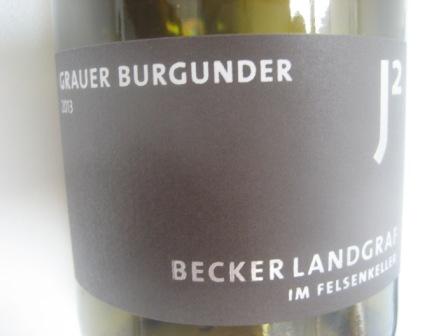
Becker-004Landgraf, Grauer Burgunder trocken 2013, Rheinhessen
A healthy yellow straw colour with a slightly reddish tinge. Smoky on the nose with pear, yellow stone fruit, reddish fruit (strawberry) and roasted hints. All this translates like-for-like onto what is a succulent palate with an excellent vein of acidity. What I like about this wine the most is this refreshing characteristic acting as a counterpoint to some good concentration. Good fun and good for the soul.

And now for somet017hing completely different.

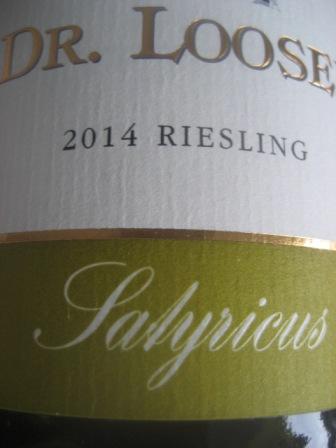
Dr. Loosen, Riesling “Satyricus” 2014, Mosel
Nose: apple, apple, apple, slate.
Palate: slate, slate, apple, apple
Alcohol: 10.5 per cent.
Murdered.

Standard

Blood, sweat and dry saliva

Alexander Laib002le broke off from father Andrea Laible’s renowned winery in Durbach and went it alone a good few years ago. He made a name for himself from the outset. I’ve tasted too few of his wines in the ensuing years to make an objective judgement. Here’s a new start.

Alexander Laible, Riesling trocken Alte Reben 2014, Baden
“SL” apparently stands for Selektion, i.e. Herr Laible has put quite some effort into this.

Textbook yellow straw in appearance. Prickly lime, red grapefruit and pineapple on the nose. However, the whiff that dominates is a combination of sweat and dry saliva. I ask myself whether it’s a dud bottle, but, as I write this, I have a glass of another Laible Riesling in front of me with the same characteristic. I would therefore conclude that sweat and dry saliva are a signature scent of the Alex Laible Collection.

Crystalline and lingering on the palate. Beautiful lime notes that almost border on sweet. A hint of grapefruit. Perfect balance … although here come the saliva flavours (I’m chuckling to myself as I write this, but it’s true). Long finish. Very drinkable. Twenty-four hours later, the sweatiness has dissipated somewhat but is still present. But here’s the bigger picture: succulent, juicy, gorgeous. A very enjoyable wine.

Standard